
Labor has avoided recession at the expense of mortgage holders
As the debate over the role of interest rates and the RBA in the Australian economy continues from the Prime Minister down to a local BBQ, the settings that have underpinned the Australian economy for decades are increasingly being questioned.
The irony is that for over 32 years, between February 1990 and May 2022, there was generally little concern about the role of monetary policy for households, as the RBA cash rate collapsed from 17.5% to 0.1%.
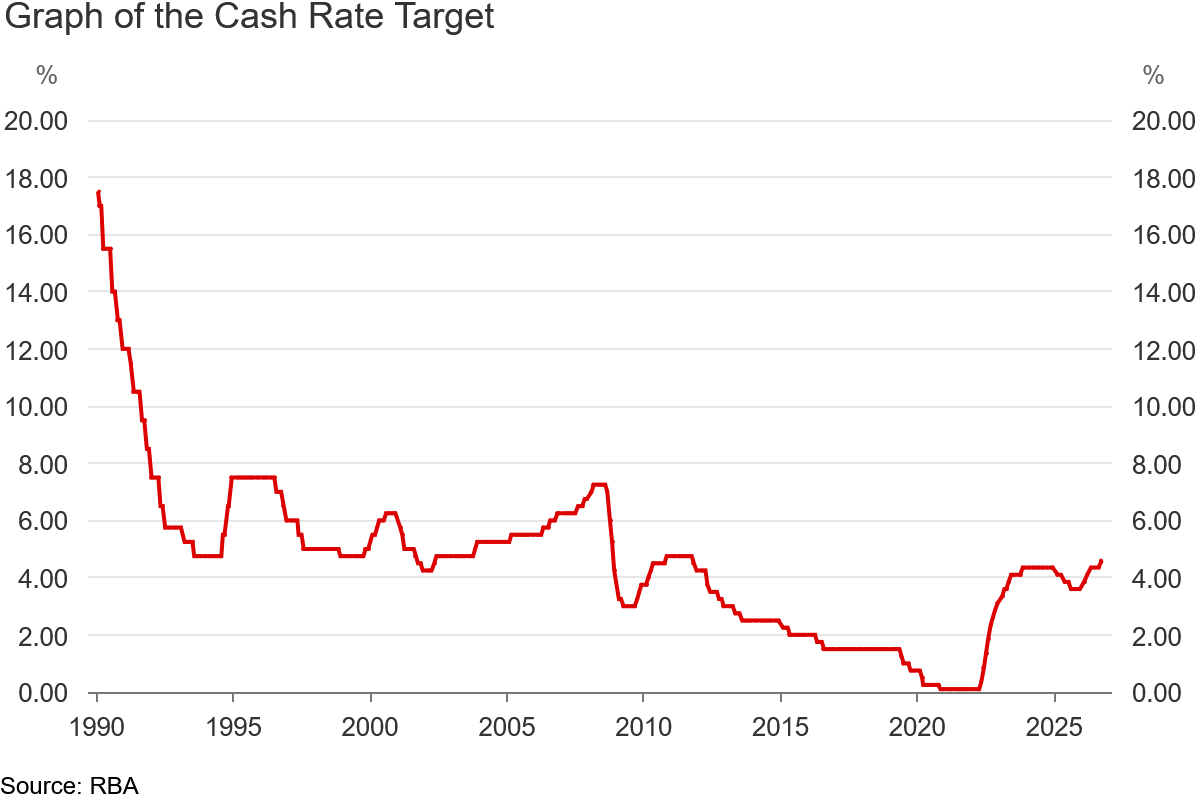
This represented the largest monetary policy shift in favour of mortgage holders in Australian history, as interest rates hit new all-time lows again and again, lowering the burden of interest costs for mortgage holders.
In contrast, the prior long-term monetary policy cycle, which played out between April 1970 and January 1990, was the polar opposite.
During that cycle, benchmark mortgage rates rose again and again, from 5.88% in early April 1970 to a peak of 17.0%, which would persist until February 1990.
In 2026, we now live in a very different world, one defined by what I have termed “Burnout Economics”.
In short, governments are now so concerned about politics that they cannot accept major economic downside without intervening, effectively putting their foot hard on the accelerator, while central banks such as the RBA have their foot hard on the brake.
Looking at the state of Australia’s economy, it’s clear we have seen this scenario play out as predicted back in early 2022.
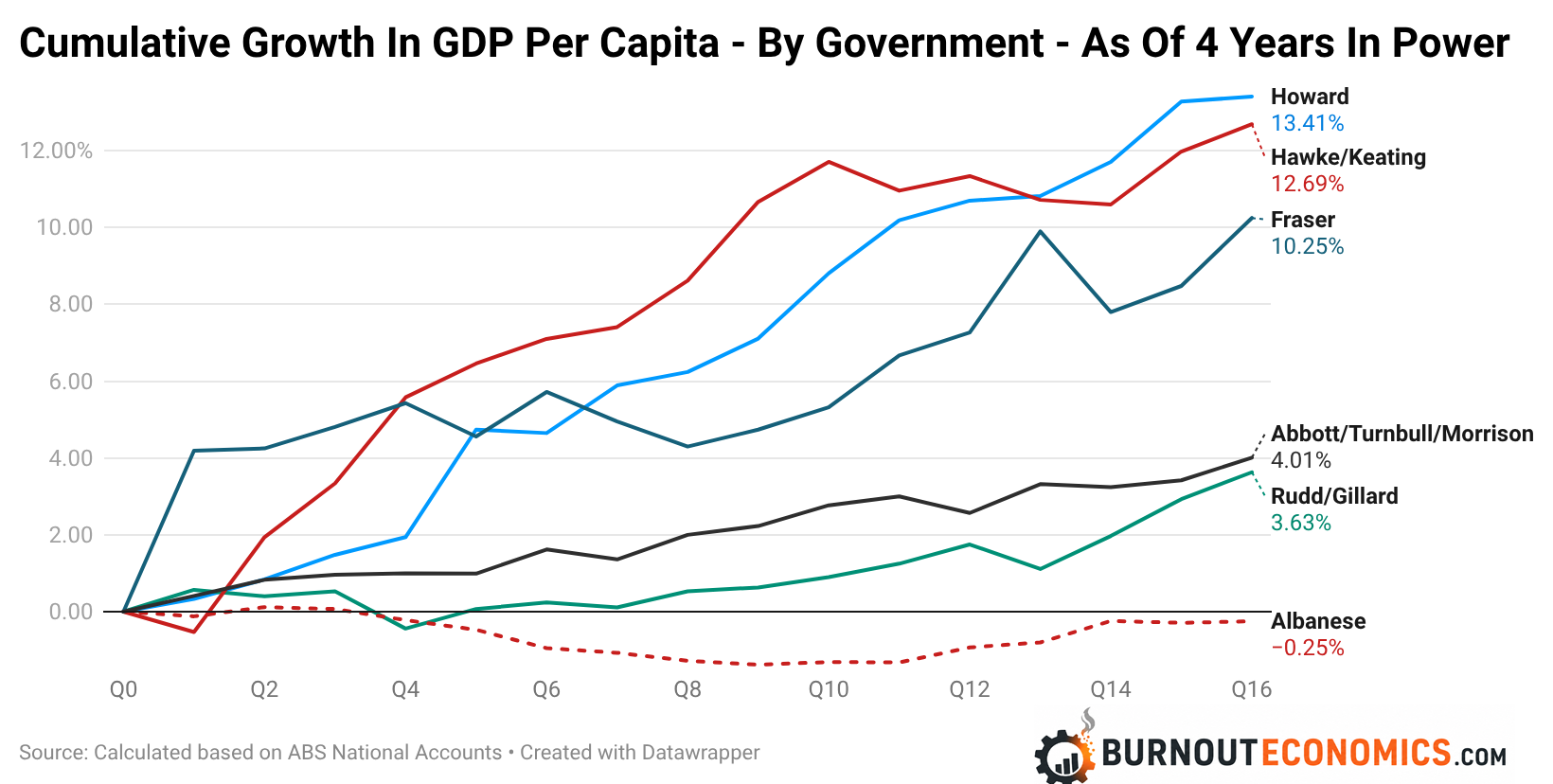
Growth in GDP per capita has gone nowhere, as productivity growth remains depressed and the labour market has become even more reliant on taxpayer-funded employment growth.
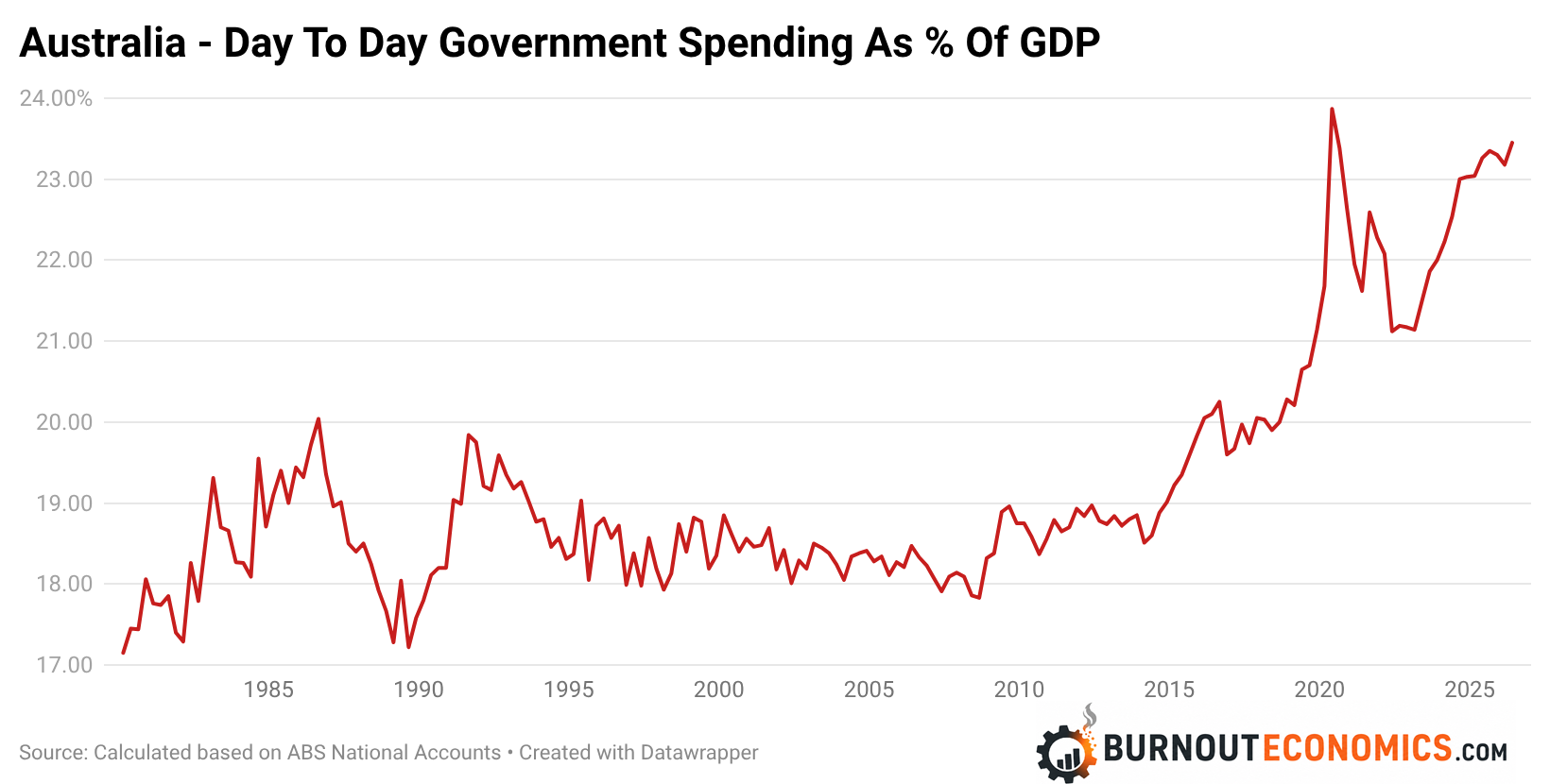
Meanwhile, day-to-day government spending has become larger and larger, rising very nearly to the levels seen during the pandemic when the kitchen sink was thrown at the economy amidst fears of an economic event akin to the Great Depression.
This has left Australia and several other nations in a position where monetary policy is increasingly ineffective, as whatever impact tightening monetary policy has is more than offset by government policy choices.
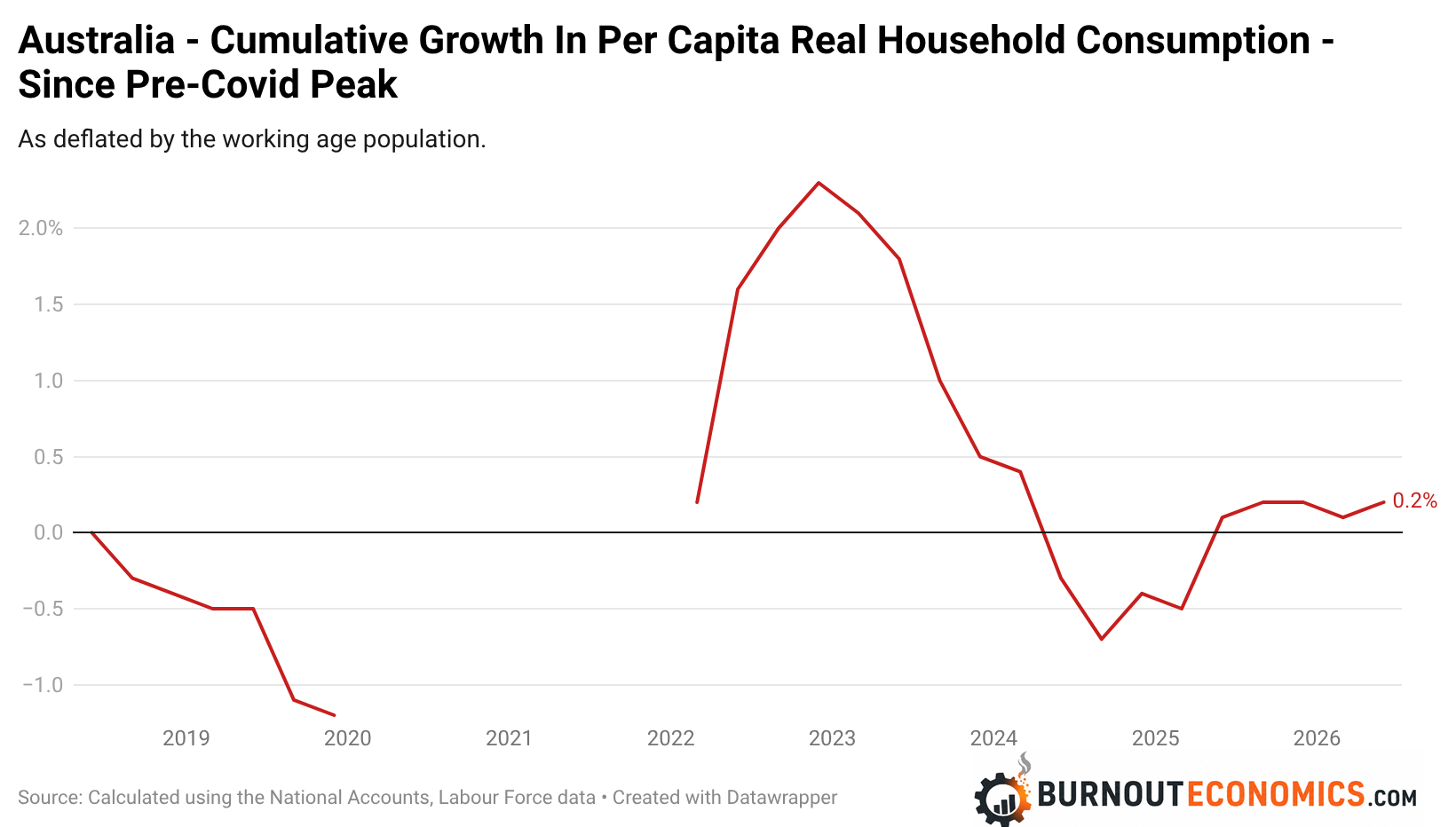
For the average Australian, this is problematic, as they continue to struggle in an environment of depressed levels of overall per capita household consumption growth masking a vast divergence between older asset-rich households and younger, less affluent ones.
But for mortgage holders, there is an additional challenge.
Instead of a more traditional scenario in which monetary policy eventually drags down inflation and slows the economy, potentially to the point of recession, this effort is blunted, which has resulted in interest rates not only staying higher but also hitting the highest level in 15 years and currently on track to hit their highest point since the era of the Global Financial Crisis.
While one can only speculate on the inner workings of the government in approaching this issue, it appears to be something it is struggling with.
The Albanese government has avoided the much-feared headline recession and produced continued headline growth, but this has come at the cost of higher inflation and interest rates remaining significantly higher than otherwise.
This is where the government is deeply vulnerable from a political perspective, as mortgage holders increasingly confront a set of circumstances with 1970s- and 1980s-style rising interest rates in relative terms, but with none of the outsized nominal income growth to offset that additional burden.
Ultimately, the reality is that the monetary policy settings of the Australian economy are here to stay, and it currently appears unlikely that any potential future government would pick up the mantle of the federal government, becoming the primary means by which high inflation was countered.
